niedziela, 28 października 2018

Królikarnia

In on of my posts two years ago I mentioned visiting a place called Królikarnia.
It's one of my favourite Warsaw places.


The palace of Królikarnia was built in 1780s for an ex soldier, Italian of origin and now on the Polish soil: a count, gambler and oportunist who made his career close to the Polish court.

The title of count was bestowed on him by the Polish king, who was apprently easily impressed - the king was a great admirer of Italy and its art - might this have been enough to invite Carol Thomatis to the court and make him a director of the national theatre? apparenty Thomatis did display some sophistication and taste in culture, but soon he showed also his greed and cunnigness. He wasn't sent to exile, though, neither was he punished;  instead he continued to live in and make fortune in Poland.


He was a nouveau riche among aristocracy and he aspired to be counted as was of them. Building a reprsentative residence on the Vistula embankment, which was already inhabited by other aristocrats, was surely an investment in prestige. Especially that he decided to hire a court architect for this job - Dominico Merlini, another Italian working for the king.
Merlini found his inspiration in Italy and likened the palace to the ideal Renaissance villa - Villa Rotonda in Vicenca.
Obviously the Polish version was less symetrical and smaller than the inspiration, yet it is counted as a descendant of Palladio's idea.


The palace and its surroundings was also an investiment from the mundane, practical point of view. After all before the palace was built first auxiliary buildings, like stables, mills etc, were erected. 
Those included the kitchen, which was built on the slope of the valley and which is one of the characteristics of the palace complex. 
This building, for a change, was likened to.. a tomb. To be more precise to mausoloem of Cecilia, which is still to be found in Rome in Via Appa.


the genius of Merlini made him build the kitchen in the gorge - thus the gorgeous building was well exposed and at the same time it didn't hinder to admire the heart of the complex where its host resided and entertained his guests - the palace .
Now it's best to admimre both in the winter, if you want to have look from the foot of the hill. now it's the lush greenery that protects the palace....


Let's make a leap in time and slightly in space. Let's enter from Puławska street.


The Królikarnia palace houses now a branch of the National Museum and it's mostly devoted to sculpture. After the war it was meant to become a studio and a living place of an renowned Polish sculptor Xawery Dunikowski, but the reconstruction of the palace took so long that the already elderly artist didn't make it to see the realisation of this plan. The project was realised only partially and the palace and its park are now an exhibition of his art...

...and not only his... and not only scultpures...


Except for both permanent and temporary exhibitions the complex often hosts concerts, cinema, picnics... and other forms of promoting art and nature.
.


An example from recent years: "nieużytki sztuki" - "wasteland of art" -  a possibility to rent a plant-pot.... and cutivate flowers or vegetables.
I think this initiative has been somewhat abanodned by now.

The beehives on the slope just below th palace are a permanent part of Króliarnia now.

The surroundings are also frequented by petanque players...

Neons - one of exhibitions from a few years back.


And below the palace complex: a natural parc with streams oozing here and there, creating a special microclimat... not so far away from the city centre!


sobota, 20 października 2018

another autumn in Warsaw

 This year I'm taking you on a short walk along the Vistula escarpment to enjoy the colours of Polish autumn.
Let's start a few steps away from the Chopin's Museum and the Warsaw Musical University...
...beside this sculpture, called "Musical Autumn"!

 On our way we will have a sneak peak above this mysterious wall and gate, which leads to the premises of a covenant - here for the last 350 years...
 The nuns' orchard is still green, presenting a beautiful contrast to the neighbouring park:
 The park used to be hospital premises. There are just two buildings there which remember the times of the 19th century hospital; now turned into a business facility.

While on this footbridge, let's have a look down - the street used to be a stream valley. Is the stream still running somewhere underneath?

 We are finishing in a park which was designed in early 50s, as a place of entertainment and relax for the working people.

sobota, 21 października 2017

A cafe with a a difference

While hiking in Warsaw, you need a coffee break. I recommend with my whole heart to look for local cafes, which will be one of a kind experience.
However if you insist on an internarionally known chainstore, why not choose a cafe with a difference?
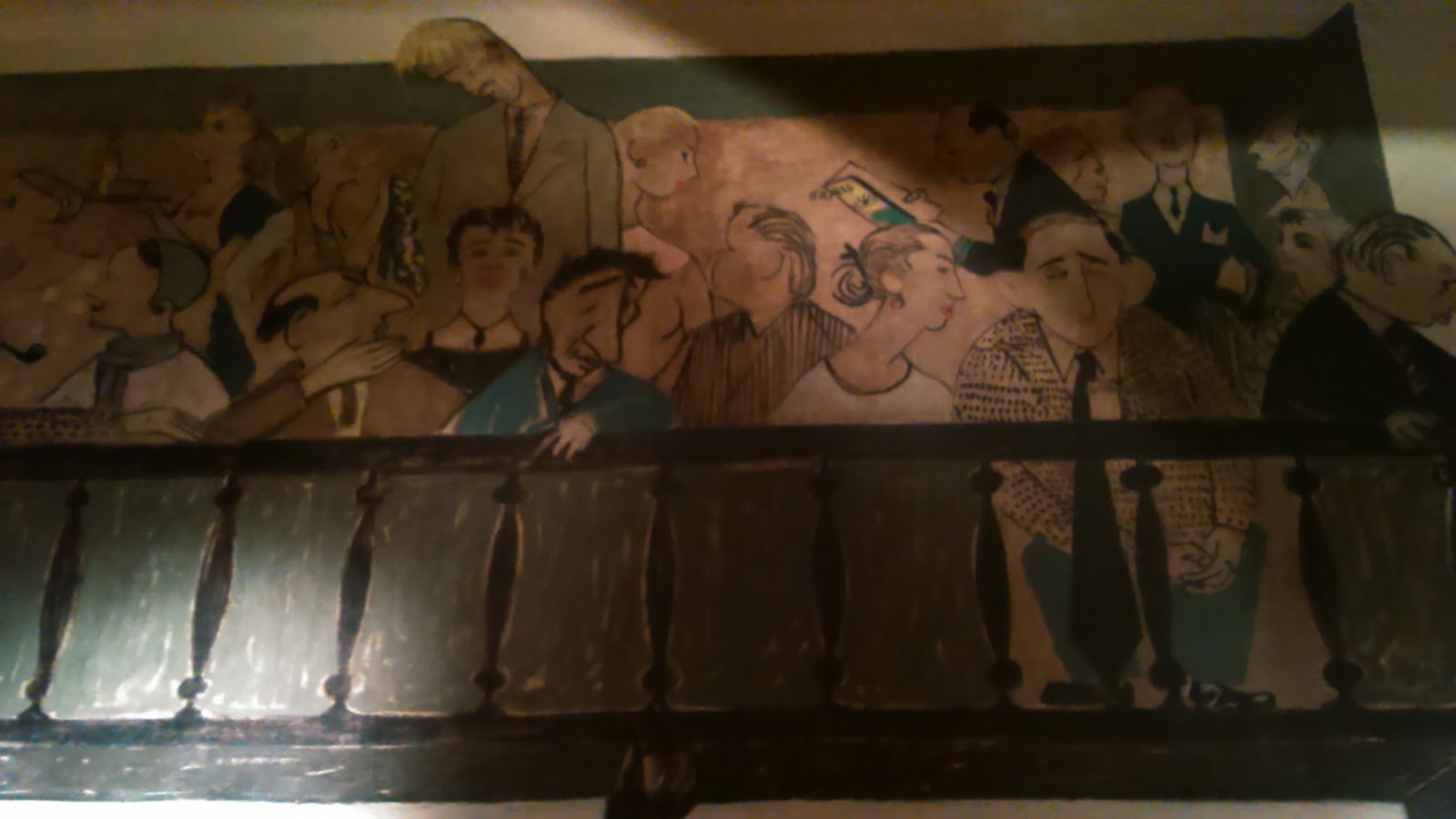
There is a S*******s cafe on the corner of Plac Trzech Krzyży. When you enter and decide to have a coffee there, you can admire some historical graffiiti from the 1950s.


The cafe was a part of the landscape since the latter part of 19th century, but its heyday falls on the 50s, when the place became a centre of literary and artisitc life of those times: poets, painters, scenograpgers, sculpturers...

Some of them started to decorate the interiors with pictures presenting the guests of the cafe, their caricatures, cartoons...


After a time, though, the place was changed into a restaurant then into a boutique... The graffiti were covered under new layers of paint and they fell into oblivion.
...almost. A few years ago when the afore-mentioned chainstore decided to set up a branch here, they also decided to recover the forgotten paintings and renovate them. (I suppose it's a rare instance of a situation when  an international corpo takes care of the local heritage... here at least).

Fancy a coffee?

piątek, 4 listopada 2016

autumn in Warsaw

 The best moment to visit - when the leaves turn red, gold and brown and all the parks and gardens become a magnificent colourful view.
 Here - a  glimpse of the Łazienki Royal Park.

piątek, 22 lipca 2016

the Castle - Upper Garden

Seen from afar, but hardly ever visited. I didn't see crowds of tourists strolling in the garden - I blame too little publicity about the availibilty of the gardens (both of them).
What a pity! both are definitely worth visiting, especially the upper part, which is arranged in a more detailed style, reminescent of baroque style geometrcial French gardens.

The visit is also a great opportunity to have a close look at the monumental 18th century facade.

The location also allows to overlook the other side of the river and the river itself, preferably while drinking a cup ofcoffee in the Zamek Cafe.
To sum up, definitely worth visiting and looking both at the town and the castle form a different angle.